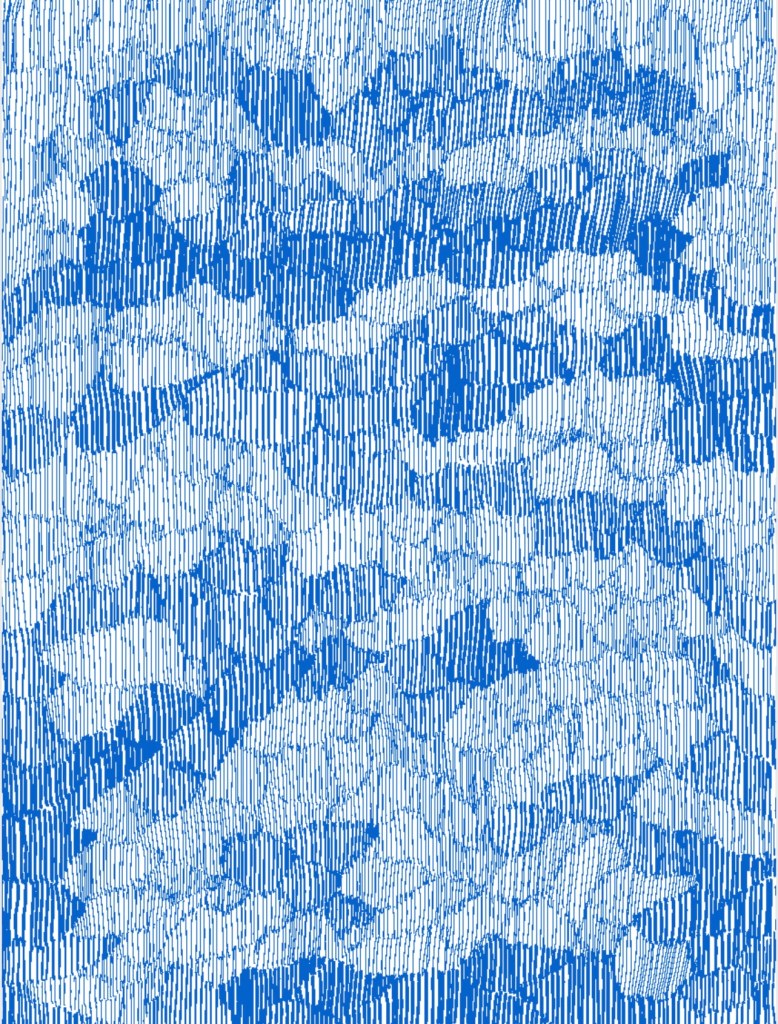
I start from a simple conviction: a surface is never just a surface. A thing that glows, a peculiar title, a quiet library room, a retrofuturist stroke, a uranium-glass cabinet, an atomic-era color field; any of these can carry an argument about memory and survival, about power, about what we’re told the future should look like.
Decoration isn’t what I’m after. What draws me is what aesthetics leave behind, the residue, the mark you can still see from longing, injury, optimism, displacement, from history pressing down hard enough to show.
As a queer Puerto Rican artist, educator, and librarian, I work in the overlaps, the spots where one world touches the next. My paintings and projects drift across nuclear history and mid-century design, colonial memory and queer otherness, teen-centered spaces, pedagogy, grief, the daily machinery of institutions. None of these live in separate rooms for me. They operate like a single, lived symbolic system, where the atomic dream keeps returning as beautiful and hazardous, political and bodily, and unmistakably haunted.
Again and again I circle back to the atomic age’s visual vocabulary: radiant color, engineered shapes, domestic objects tuned to an idea of modern life, scientific diagrams, architectural optimism, that slick promise of a future made clean by technology. Yet what grips me just as much is what’s left when the promise breaks. Who got to belong inside those visions of progress, and who paid for them? Which stories were pushed out of frame? What continues to glow once the official narrative has already moved on?
A lot of my work is an attempt to give form to forces that prefer to stay unseen. Radiation, memory, adolescence, colonialism, queerness, architecture, grief, institutional power: they move like atmospheres. They seep into bodies and rooms, into objects and images, until you can’t tell where they start or stop. I tend to think of my practice as weather: pressure building, systems gathering, then something taking shape. Abstraction meets research, teaching brushes up against collecting, and world-building becomes another way to name what’s happening.
Working with young people in library spaces keeps questions of belonging and legibility close to the surface. I keep thinking about how people, especially teens and communities that have been pushed aside, come to recognize themselves inside structures that weren’t built with them in mind. That’s where my library work touches my studio work. Both keep asking how space, image, language, and care can set conditions in which someone becomes more visible to themselves.
I don’t work in a straight line. My natural mode is braided: personal anecdote threaded through theory, historical reference crossing institutional critique, poetic language alongside material experiment, all held together by an emotional climate. I push back against the idea that clarity has to mean flattening. The density matters. The oddness matters too; it’s part of what counts as evidence.
When it works best, the work won’t let the aesthetic and the wound be separated. Beauty stays beside danger. Nostalgia is handled with suspicion, but not with contempt. I keep looking for the future tucked inside the ruins of older futures. And I ask the viewer to stay with the glow long enough to notice it isn’t only light. It’s history, desire, warning, and survival all at once.
 Ángel Rafael Vázquez-Concepción