
Seen under ultraviolet light, uranium glass gives itself away; it blooms into a ghostly green glow that has kept collectors and makers intrigued for almost two hundred years. Recognizable for its bright yellow-to-green tones, this odd little category of glass sits where craft meets chemistry and where taste meets history. From the busy Bohemian workshops of the 1800s to the shelves and display cases of today’s fans, its path traces a small but telling record of how people experiment, borrow ideas, and turn technical discoveries into beauty. Pieces such as Karl Palda’s scarce Art Deco vase show what that can look like at its best, a single object carrying science, style, and cultural fashion in the same breath. The thread starts in the early nineteenth century, but one key moment comes earlier.
In 1789, the German chemist Martin Heinrich Klaproth identified uranium and noticed it could serve as a pigment. By the 1830s, decades later, glassmakers in Bohemia, already famous for their skill, began adding uranium dioxide to their batches. The payoff was immediate: glass that naturally took on a clear yellow or a green cast, unlike the colors people were used to seeing. Interest spread fast enough that by 1838, factories such as Choisy-le-Roi in France were producing uranium glass as well. (The Glass Museum)
Within the Habsburg Empire, Bohemia became one of the main centers of production. The mix of accessible raw materials and trained hands mattered, but so did the wider climate, a place where makers had room to try new recipes, and customers were ready to reward novelty. With Habsburg support for the arts helping to keep fashionable objects in demand, uranium glass moved from a technical curiosity into a desirable material across Europe.

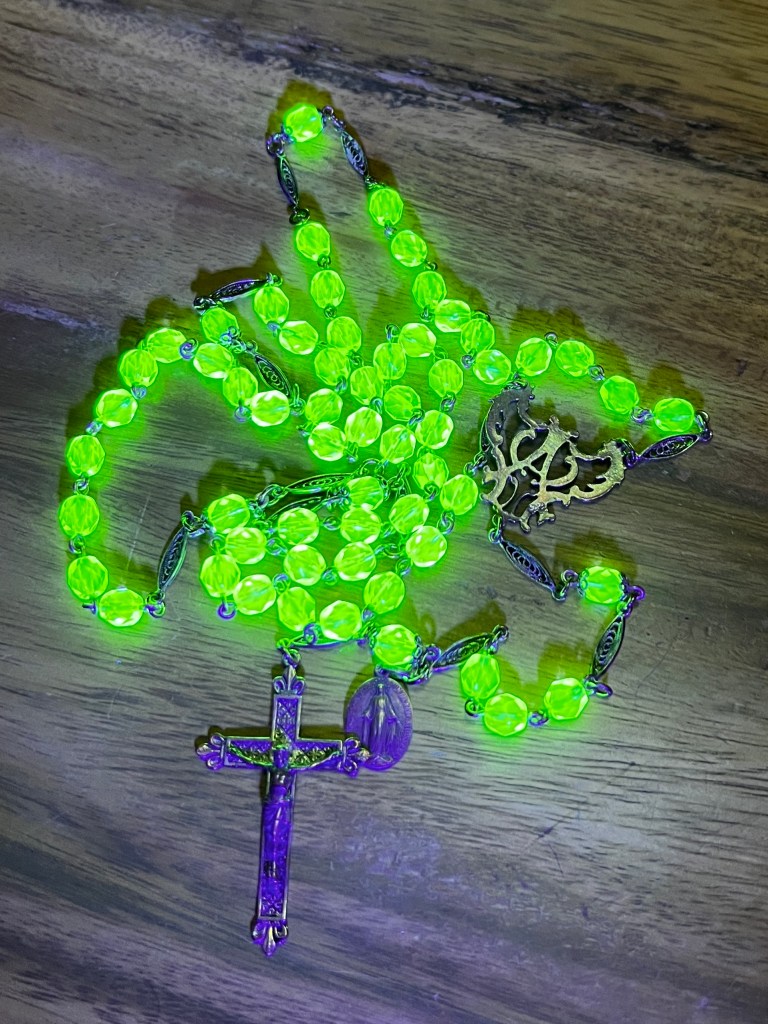
Uranium glass gets its vivid color from uranium oxides incorporated into the batch. Once those oxides melt into the glass, they can tint it anywhere from a soft, watery green to a richer yellow that looks as if it’s lit from within. Uranium dioxide shows up most often, and when it’s stirred into molten glass, it also gives the finished piece an unusual trick: it glows under ultraviolet light. That glow completely changes the feel of an object; the same bowl or vase stops reading as ordinary and starts to look like something made to be stared at.
Back in the early 1800s, the first uranium glass appeared in Bohemia, and the story is less grand design than lucky misstep. Glassmakers there, already famous for what they could coax out of a furnace, noticed that adding uranium compounds made their work shine in a way they hadn’t seen before. Word moved fast. Soon, workshops around Europe caught on, from Venice to France to Britain, and each place began testing the material in its own way, folding local tastes and techniques into what was quickly becoming a new kind of craft.
Victorian England had a taste for the new and the far-flung, so uranium glass didn’t take long to catch on. People often called it “Vaseline glass,” a nickname pulled from its pale yellow, jelly-like look. Before long, it stood for progress and for the kind of wonder modern science seemed to promise. To Victorian eyes, these luminous pieces weren’t just pretty things on a shelf; they felt like proof that humans could take nature’s strange, hidden forces and turn them into something both useful and beautiful.
Like many European ideas, uranium glass crossed the Atlantic and landed in the United States, where it was quickly adopted by American glassmakers. By the end of the 1800s and into the early 1900s, U.S. workshops, including artisans working for the Fenton Art Glass Company, were producing uranium glass that could stand alongside Europe’s best. Whether they showed up as tableware or vases, the soft glow of these pieces made them sought after in American homes, carrying a mix of inventive spirit and craftsmanship.

Still, as the 20th century rolled on, uranium glass slipped out of fashion. Nuclear science was moving fast, and once the atomic bomb entered the story, the material no longer felt harmless. Uranium had carried a whiff of elegance and lab-bench curiosity, then it got tangled up with global dread and images of devastation. With that shift, makers largely pulled back, production dropped off hard, and uranium glass started to read like a leftover from another age, a strange keepsake from a moment when art and science seemed to walk side by side. Interest didn’t stay quiet forever.
When black lights appeared in the early 1900s, uranium glass suddenly entered a new stage. Put it under ultraviolet light, and it doesn’t just glow; it flares into an almost uncanny green, vivid enough to feel otherworldly. That simple trick of physics, UV meeting uranium, hooked collectors and deepened the appeal. Pieces that used to sit on a shelf as pleasant decoration turned into small spectacles, and that sense of surprise helped keep the material in circulation among newer fans. Now it’s firmly in collectible territory, and the crowd around it is a mixed, enthusiastic bunch. Well-known collectors such as Dan and Lisa Sawyers have gathered hundreds of examples, not only jewelry, but also finely carved serving ware and playful odds and ends, including bird-shaped salt dips. Their own story began by accident, with a glowing shard of sea glass found on the shore of Lake Superior, a lucky find that sparked a lasting fascination with uranium glass (Atlas Obscura).
Health physicist and devoted uranium glass collector Phil Broughton tends to view the material through a lab-minded lens. In his view, simply handling uranium glass is generally far less risky than dealing with many other radioactive substances. He also argues that it deserves a little admiration, since it sits neatly between art and science, serving as a link between the two (Atlas Obscura).
Dave Peterson, who co-founded Vaseline Glass Collectors, Inc., has played a key role in keeping the story of uranium glass alive through his writing and the community he’s brought together. With a careful, research-minded approach, he’s helped connect collectors around the world who value both the craft behind the pieces and the history they carry (Collectors Weekly).
Being a collector, I’m drawn to uranium glass for two reasons at once, what it looks like, and what it has lived through. Over time I’ve built up a collection that stretches well beyond one place, including rare Taisho-era uranium glass clocks alongside pieces sourced from different corners of the world, a quiet reminder of how far this material traveled and why it still holds people’s attention. For me, it doesn’t sit on a shelf as “just” a collectible. Uranium glass feels like a way to tell stories, casting light on that meeting point where invention and beauty keep crossing paths, from one culture and period to the next.

References
- Antique Answers. (n.d.). Uranium Glass Manufacturing: When and Where It Was Made. Retrieved from https://antiqueanswers.com/uranium-glass-manufacturing-when-and-where-it-was-made/
- Atlas Obscura. (n.d.). How collectors are preserving the radioactive glow of uranium glass. Retrieved from https://www.atlasobscura.com/articles/uranium-glass-radioactive-plates-cups
- Collectors Weekly. (n.d.). These people love to collect radioactive glass. Retrieved from https://www.collectorsweekly.com/articles/these-people-love-to-collect-radioactive-glass/
- ORAU Health Physics Museum. (n.d.). Vaseline and Uranium Glass. Retrieved from https://orau.org/health-physics-museum/collection/consumer/glass/vaseline-uranium-glass.html
- The Collectors Who Hunt Down Radioactive Glassware. Retrieved from https://www.atlasobscura.com/articles/uranium-glass-radioactive-plates-cups
- These People Love to Collect Radioactive Glass. Are They Nuts? Retrieved from https://www.collectorsweekly.com/articles/these-people-love-to-collect-radioactive-glass/
- Vaseline and Uranium Glass (ca. 1930s). Retrieved from https://orau.org/health-physics-museum/collection/consumer/glass/vaseline-uranium-glass.html
- Uranium glass – Wikipedia. Retrieved from https://en.wikipedia.org/wiki/Uranium_glass

