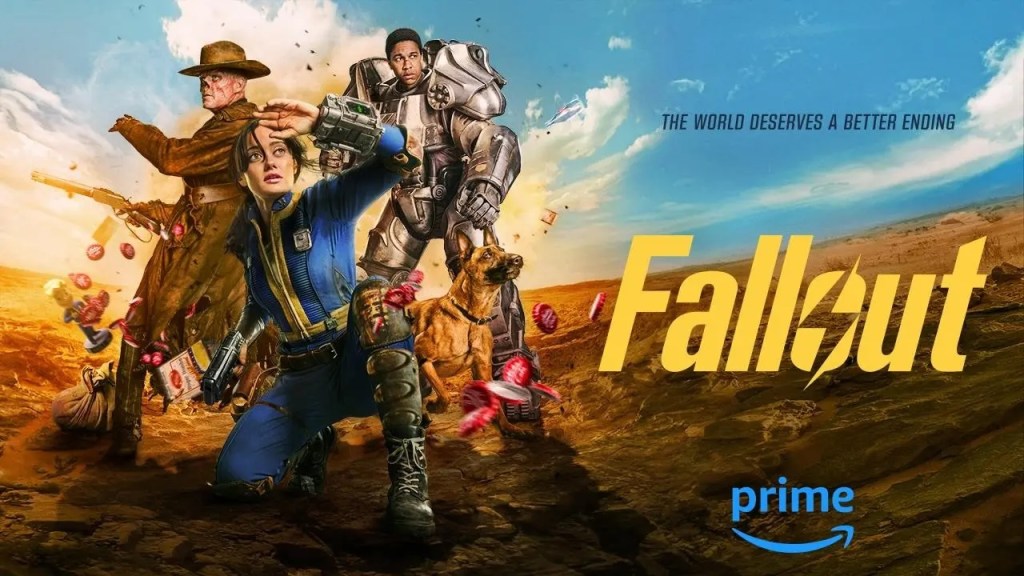
Amazon’s Fallout plunges viewers into a harrowing vision of Los Angeles, transformed by nuclear catastrophe into a desolate wasteland where survival hinges on life in underground bunkers. This TV adaptation of the renowned Bethesda Studios video game series, helmed by Geneva Robertson-Dworet and Graham Wagner, finds a unique voice within the dystopian genre by engaging deeply with the existential dread of nuclear disaster—an echo of the Cold War’s haunting legacy that still resonates today.
The series’ setting itself is a vivid character: the claustrophobic bunker interiors starkly contrast with the expansive wasteland above, serving as a perpetual visual reminder of the nuclear devastation. This isn’t just speculative fiction but a thoughtful reflection on historical anxieties about nuclear power, articulated through meticulous production design—from rusted bolts to decaying facades—each detail accentuates lingering atomic fears’ dangers.
At the narrative’s core are the nuanced performances of Ella Purnell, Aaron Moten, and Walton Goggins. Purnell’s Lana is portrayed with resilience, symbolizing humanity’s struggle against its bleak future. Goggins plays The Ghoul, a leader whose dangerous charisma mirrors the lethality of the radioactive dust that pervades their world. However, Aaron Moten’s Maximus captivates deeply, embodying the heart of the series’ exploration of morality and human endurance.
Maximus, a squire within the Brotherhood of Steel, is a character who brings to life the ethical and moral complexities of living in a post-apocalyptic society. The Brotherhood, a militant group known for its technological acumen and rigid moral code, provides a perfect backdrop against which Maximus’s journey unfolds. His role challenges him to reconcile the Brotherhood’s often harsh dictums with his growing sense of justice and empathy. As he navigates through political intrigue and the hazards of the wasteland, Maximus evolves from a naive squire into a critical thinker questioning the very foundation of his allegiance.
His relationships with other characters, particularly with Lana and The Ghoul, further highlight his internal and external conflicts. Lana’s determination and hope contrast Maximus’s initial skepticism and strict adherence to the Brotherhood’s rules. Meanwhile, his interactions with The Ghoul, filled with tension and philosophical debate, underscore the complexities of leadership and power in a fractured world. These dynamics are pivotal, as they drive the story forward and deepen the viewer’s understanding of the precariousness of post-apocalyptic governance and the moral quandaries faced by those in power.
Fallout smartly utilizes its video game roots to craft a narrative that reflects on a timeline diverged by nuclear proliferation in peacetime—an exploration that resonates with contemporary fears and historical what-ifs. The show’s commitment to addressing the implications of nuclear energy and its potential for widespread devastation is both timely and timeless, offering a narrative experiment that reveals as much about our present and future as it does about an imagined alternate history.
Despite its profound themes and visual strengths, the series sometimes struggles with pacing and narrative cohesion. The ambition of intertwining multiple plot lines occasionally results in a fragmented narrative, mirroring the broken society it depicts. At times, the dialogue stretches for philosophical depth but falls short, somewhat marring the otherwise compelling flow of the story.
Nevertheless, the series excels in its unflinching engagement with themes of governance after catastrophe, the ethics of survival, and the enduring essence of humanity. Fallout challenges viewers to consider the morality of using atomic weapons and old-world politics in shaping new societal norms. It invites contemplation on power and responsibility in a world irrevocably altered by human actions.
On the surface, mutants and marauders, symbols of the mutative potential of radiation, remind viewers of the biological and environmental repercussions that might still be unleashed by the atomic age. These characters are not just antagonists but represent the enduring human folly and the continuous threat of nuclear proliferation. Their depiction is critical commentary, enriching the show’s exploration of the consequences of human hubris and technological misuse.
Fallout is not merely a product of speculative fiction, but a reflective critique of mid-20th-century American society reimagined through dystopian fears and nuclear anxiety. By combining rich visual storytelling with profound thematic inquiries, the series not only enriches the post-apocalyptic genre but also compels us to confront the possibility of our own demise and the challenging promise of new beginnings in the shadow of atomic dread. As the series progresses, one can only hope it continues to delve into these profound themes with the same boldness and depth that have characterized its compelling debut.
 Ángel Rafael Vázquez-Concepción