James Leroy Acord (1944–2011) was a singular figure in contemporary art, known for his audacious integration of sculpture and nuclear science. As the only private individual licensed to own and handle radioactive materials, Acord’s work transcended traditional art forms, grappling with the complex history of nuclear engineering, the ethical dilemmas surrounding atomic waste, and humanity’s fraught relationship with technology. His life and legacy remain a tribute to the power of interdisciplinary collaboration and the capacity of art to confront the existential questions of the nuclear age.
Alongside artists like Julie Mehretu and Beatriz Milhazes, Acord has left an indelible mark on my artistic practice, which seeks to combine their approaches into a unified interdisciplinary praxis. Where Mehretu’s layered abstraction maps geopolitical and historical forces, and Milhazes celebrates the vibrant fusion of pattern, culture, and movement, Acord’s work takes us into the visceral and material realities of our atomic age. Together, these three artists inspire a mode of creating that is as intellectually rigorous as it is aesthetically transformative, urging me to explore the intersections of science, politics, and cultural memory.
*
Born in Newport, Washington, Acord’s formative years coincided with pivotal moments in American history. The Cold War was in full swing, and the race for nuclear supremacy shaped geopolitics and popular culture. Acord grew up in a world permeated by the promise and peril of nuclear technology, a duality that would later become the foundation of his artistic practice. His early exposure to these conflicting narratives of nuclear technology and his fascination with the permanence and resilience of granite, a material he admired, laid the groundwork for his later exploration of the integration of stone with metal and other materials.
Acord began his artistic journey working with granite, a material he admired for its permanence and resilience. His early career as a union sculptor in Barre, Vermont, grounded him in traditional stone carving techniques. Yet even in these formative years, he was restless, seeking to explore the integration of stone with metal and other materials. The realization that granite contained uranium catalyzed a profound shift in his artistic vision, prompting him to engage with the nuclear age conceptually and materially.
Acord’s focus on the granular—down to the uranium atoms within granite—reflects this shared reverence for the hidden complexities within materials.
*
In 1986, Acord moved to Richland, Washington, home to the Hanford Nuclear Reservation—a site deeply entwined with the history of nuclear weapons and energy production. For 15 years, he lived among scientists, engineers, and nuclear industry workers, immersing himself in nuclear technology’s technical and ethical complexities. His ultimate ambition was to construct a ‘nuclear Stonehenge’ on contaminated land at Hanford, incorporating twelve uranium breeder-blanket assemblies. This ambitious project, which aimed to create a monumental structure that would serve as a physical and conceptual reminder of the legacies of the atomic age, exemplified his commitment to making art that could confront these legacies and sparked essential discussions about the intersection of art, science, and ethics.
Hanford’s significance cannot be overstated—it was the birthplace of the plutonium used in the bomb dropped on Nagasaki. Acord saw in its history both the triumphs of human ingenuity and the moral failings of unchecked technological progress.
Living in Richland allowed Acord to engage directly with the infrastructure and history of the nuclear industry. He spent countless hours studying reactor designs and collaborating with experts to understand the principles of atomic physics. This intellectual immersion informed his art and his advocacy for more excellent public dialogue about the ethical dimensions of nuclear technology.
*
Acord’s work stands out for its direct engagement with radioactive materials. He legally acquired depleted uranium from Germany’s SNR-300 reactor and incorporated these materials into his sculptures. His most famous piece, Monstrance for a Grey Horse, is a striking example of his ability to fuse art and nuclear science. Installed at Southwestern University in Texas, the sculpture serves as a relic and a commentary on the atomic era.
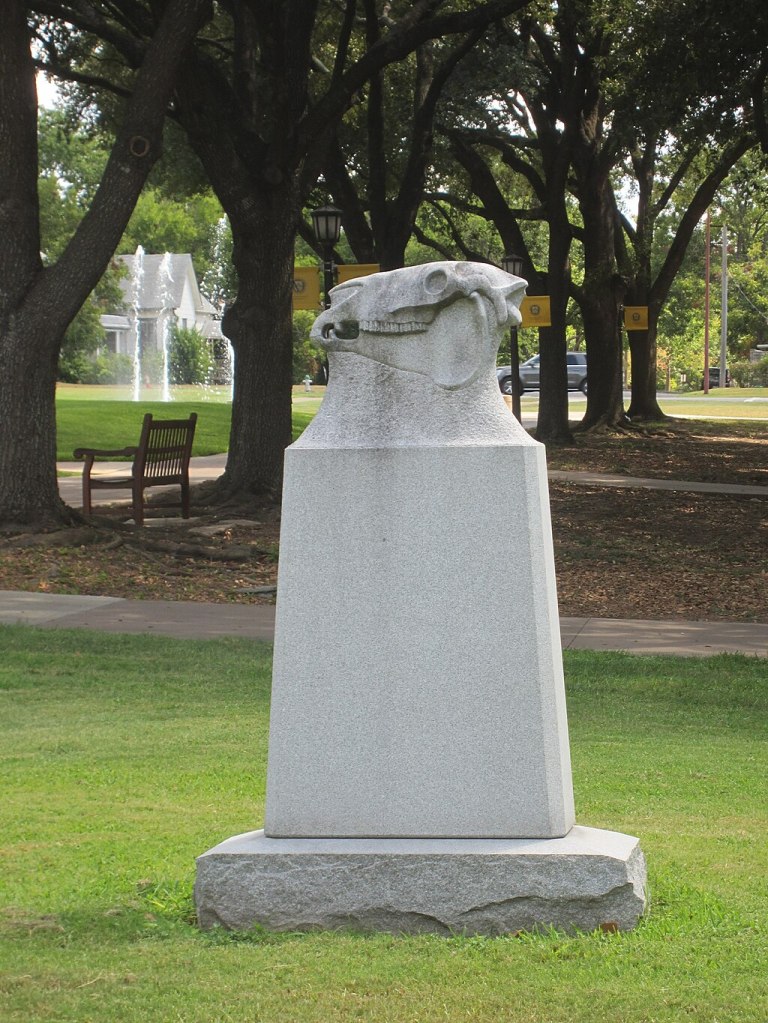
Monstrance for a Grey Horse is a granite sculpture of a horse’s skull on a pedestal by James Acord, installed on the Southwestern University campus in Georgetown, Texas, United States. The university donated it to alumnus Joey King, who purchased the artwork from the sculptor in 2000.
Monstrance for a Grey Horse takes its name from a liturgical object used to display sacred relics, connecting the piece to themes of reverence and ritual. The “grey horse” refers to the fallout of the nuclear age—the radioactive clouds that would spread invisibly across the sky. This work exemplifies Acord’s ability to translate profound historical and scientific realities into poignant visual forms.
One of Acord’s most provocative projects was his attempt to create plutonium for inclusion in his Fifth Reliquary. He demonstrated how easily radioactive substances could be manipulated using everyday materials like crushed Fiestaware and smoke detectors. While the quantities of plutonium produced were minuscule and intended solely for conceptual art, the project highlighted the contradictions and vulnerabilities in nuclear regulation. This work underscored his critique of atomic technology’s secrecy and its implications for public understanding.
*
Acord’s life and work unfolded against global debates about nuclear disarmament. The 1986 Chornobyl disaster—the same year Acord moved to Hanford—underscored the catastrophic risks of nuclear energy. His art became a form of silent protest, engaging these issues without polemic but with profound symbolism.
In 1997, Acord spoke at an event marking the 50th anniversary of the United Nations, where his remarks about the ethical responsibilities of artists and scientists left a lasting impression.
Music also deeply influenced Acord’s practice. A fan of Bob Dylan, Acord often cited A Hard Rain’s A-Gonna Fall as encapsulating the anxieties of the nuclear age. Russian composer Dmitri Shostakovich’s symphonies, marked by themes of war and resilience, also shaped Acord’s conceptual framework, informing the rhythm and structure of his sculptures.
A Hard Rain’s A-Gonna Fall, live at Carnegie Hall, New York City, October 1963.
*
Acord’s death by suicide in 2011 marked the end of a career defined by bold experimentation and relentless inquiry. Yet his work continues to inspire discussions about the role of art in addressing technological and ethical challenges. Acord’s sculptures explore the hidden dimensions of the atomic age.
His influence extends beyond the art world. Acord’s collaborations with scientists and his ability to communicate complex ideas have inspired a new generation of artists, engineers, and thinkers to consider the intersections of creativity and technology. His vision of a “nuclear Stonehenge” remains a perpetual symbol of how art can illuminate the complexities of our world.
*
References
Adams, R. (2012, January 29). Making art with radioactive materials—In memory of James Acord. Atomic Insights. Retrieved from https://atomicinsights.com/making-art-with-radioactive-materials-in-memory-of-james-acord/
Egalore. (2011, May 7). James L. Acord: Remembering the artist and his work. James L. Acord Memorial Blog. Retrieved from https://jamesacord.com/
Michaud, J. (2011, January 20). Postscript: James Acord, alchemist for the nuclear age. The New Yorker. Retrieved from https://www.newyorker.com/books/double-take/postscript-james-acord-alchemist-for-the-nuclear-age
Wikipedia contributors. (2024, November 13). James Acord. Wikipedia. Retrieved from https://en.wikipedia.org/wiki/James_Acord
 Ángel Rafael Vázquez-Concepción