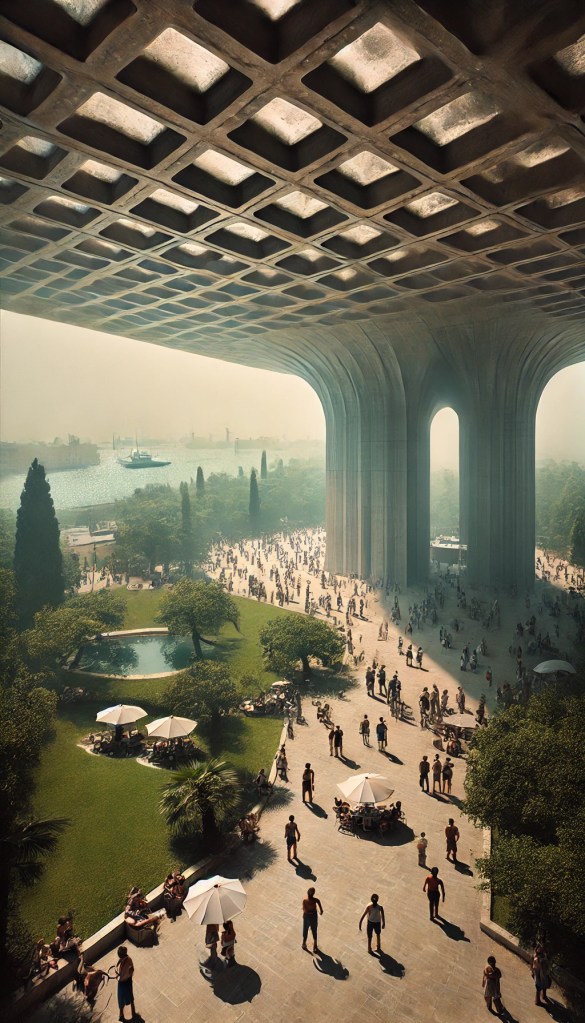
The early afternoon sun cast a golden glow over Venice, its light fractured by the rippling waters of the canals. But the seas were higher than ever, lapping at the edges of ancient stone buildings and newly constructed platforms. The hum of sump pumps echoed through the streets, an unspoken acknowledgment of the city’s precarious future. Yet, amidst this, the Biennale stood as a beacon of inspiration, exemplifying human creativity and resilience.
A group of friends sat outside a café in Campo Santa Margherita, their conversation lively as they sipped coffee and shared their plans for the day. Around them, the chatter of other patrons blended with the sound of distant church bells and the occasional chatter or slosh of a passing gondola.
“The Giardini is going to be packed,” Clara said, adjusting her wide-brimmed hat. A high school teacher and art enthusiast, she had been looking forward to this visit for months. “Have you seen the buzz about the nuclear energy pavilion?”
Mateo, an engineer with a soft spot for architecture, nodded. “Designed by Greenfield & Co. from San Francisco. Brutalist, but with those signature curves and glass they’re known for. It’s supposed to be stunning.”
Mariam, an artist with a weathered sketchbook, raised an eyebrow. “Nuclear energy at the Biennale? That’s… unexpected. But this element of surprise makes the Biennale so fascinating, isn’t it?”
“Unexpected, but overdue,” Akil, a climate activist, interjected. “It’s time we moved away from pavilions just showcasing flags and nationalism. The world’s problems don’t have borders.”
The friends finished their coffees and made their way toward the Giardini, weaving through narrow alleys and over footbridges that creaked under the strain of elevated platforms—minor signs along the way marked water levels from past floods, some recent, some from decades ago. The markings told a silent story of Venice’s slow surrender to the sea.
The Biennale’s vibrancy surrounded them: the hum of visitors, the kaleidoscope of languages, and the avant-garde installations peeking from behind manicured hedges. Yet there was an undercurrent of melancholy. Temporary walkways had become permanent features, and gondoliers joked darkly about needing diving licenses.
The nuclear energy pavilion towered ahead, its brutalist structure a harmonious blend of strength and transparency. Curved concrete walls wrapped around open spaces, while massive panes of glass reflected the lush greenery—and the ever-present water below. The entrance was understated, marked by a sleek sign: Energy Beyond Borders.
Inside, the atmosphere shifted. A soft hum pervaded the air, a blend of audio design and subtle vibrations meant to evoke the quiet power of nuclear reactors. The first gallery space introduced visitors to the fundamentals of atomic energy, with interactive exhibits explaining fission, containment, and waste management. The displays were informative and immersive, with holograms and augmented reality overlays bringing complex concepts to life.
“This is incredible,” Mateo said, examining a reactor core simulation. “They’ve made the science so accessible. Even the design feels… respectful like it understands the subject’s weight.”
The group moved into the next room, which featured a series of paintings by Ralph Vázquez-Concepción. The canvases were large and vivid, each piece meditating on the interplay between human ingenuity and natural forces. Swirling colors and seismic lines hinted at the tensions of living in a nuclear age—the beauty of progress juxtaposed with the gravitas of responsibility. One particularly striking piece depicted a radiant core wrapped in turbulent waves, the colors and lines seemingly in motion.
“These are stunning,” Mariam said, her voice tinged with awe. She sketched furiously, capturing the essence of a piece that resembled a radiant nuclear core wrapped in turbulent waves. “It’s like he’s painting the energy itself.”
“And the fear,” Clara added. “Look at those edges, how they almost seem to burn.”
The final gallery housed the centerpiece of the pavilion: a nuclear waste containment cask. It stood solitary on a polished concrete plinth, its surface matte white and unyielding. Visitors circled it, their expressions mixing curiosity, reverence, and unease. A nearby plaque read:
Designed to Endure: A Monument to Human Responsibility.
“This feels like the future and the past colliding,” Akil said, stepping closer. “It’s a reminder of our promises to ourselves and the generations to come.”
“But is it art?” a voice nearby interjected. The speaker, a young man in oversized sunglasses, gestured at the cask. “This belongs in a science museum, not the Biennale.”
“It’s absolutely art,” another visitor countered, her tone sharp. “Art isn’t just beauty—it’s about provoking thought. This does that and more.”
Clara turned to her friends. “It’s interesting to see how polarized people are. This isn’t just a conversation about nuclear energy; it’s about trust, ethics, and how we define progress.”
“And how we tell our stories,” Mateo added. “This pavilion feels like a declaration that humanity can innovate responsibly.”
The group spent the rest of the afternoon exploring other pavilions, their minds still buzzing from the nuclear energy exhibit. As they wandered through the Giardini, they reminisced about the Ocean Pavilion from previous Biennale editions—a standout that had left an indelible mark on their collective memory.
The Ocean Pavilion, a standout from previous Biennale editions, had been a multisensory experience, immersing visitors in the depths of marine ecosystems through cutting-edge technology and art. Interactive installations allowed attendees to ‘swim’ with virtual sea creatures while the sounds of whales and crashing waves filled the space, creating an otherworldly ambiance. The pavilion’s design often incorporated elements that mimicked the fluidity and vastness of the ocean, with flowing fabrics and reflective surfaces enhancing the immersive experience. It also featured a striking exhibit on coral bleaching, serving as a stark reminder of how fragile these ecosystems are.
“Remember the jellyfish room?” Mariam said, her eyes lighting up at the memory. “The way the lights pulsed in sync with our movements was like being part of a living organism.”
Clara nodded. “It was beautiful but also haunting. The exhibit on coral bleaching was a stark reminder of how fragile these ecosystems are.”
Ever the environmental advocate, Akil added, “The Ocean Pavilion highlighted our dependence on marine environments and the urgent need to protect them. It’s a conversation that ties directly into what we saw today about energy and sustainability.”
The Ocean Pavilion’s emphasis on interconnected ecosystems resonated deeply with the Nuclear Pavilion’s focus on shared energy futures. Both challenged visitors to consider humanity’s impact on the planet and the responsibilities that come with technological advancement.
As the friends continued their journey through the Biennale, they couldn’t help but draw parallels between the pavilions. The rising waters of Venice served as a poignant backdrop, underscoring the themes of environmental fragility and resilience. The physical toll of the day—aching feet from traversing the expansive exhibition spaces, the weight of humidity in the air—mirrored the mental exhaustion of grappling with complex global issues presented through art.
“It’s overwhelming,” Mateo admitted as they rested on a bench overlooking the lagoon. “But I’m grateful we’re experiencing this together. We need to have these conversations, and it’s easier to process with friends by your side.”
The others murmured in agreement, each lost in their thoughts. The Biennale challenged them, pushing the boundaries of their understanding and leaving them with more questions than answers. Yet, in the company of friends, the weight of these revelations felt more bearable.
As the sun dipped below the horizon, casting a golden hue over the flooded streets, the friends made their way back through the city. The high tide had receded slightly, but the dampness lingered—a reminder of the ever-present threat of rising sea levels. With its beauty and vulnerability, Venice stood as a testament to human creativity and the challenges ahead.
The friends often reflected on their experiences at the Biennale in the following days. The conversations sparked by the pavilions continued, influencing their perspectives and actions. They knew that the art they had encountered was more than mere exhibition; it was a call to action, a plea for awareness, and a catalyst for change.
As they navigated their lives beyond Venice, the memories of the Biennale—the nuclear pavilion, the Ocean Pavilion, the rising waters—remained a constant reminder of the interconnectedness of art, humanity, and the planet they call home.
“There’s a connection here,” Akil said. “Energy, oceans, climate… It’s all part of the same conversation. We can’t afford to see these issues in isolation anymore.”
As they sat by the water’s edge that evening, the sky painted in hues of apricot and indigo, their conversation lingered on the day’s experiences. The tide was higher than when they’d arrived, lapping at their shoes.
“The nuclear pavilion is a bold statement,” Clara mused. “It’s saying that art doesn’t just reflect culture; it can challenge it and push it forward.”
“It’s also about optimism,” Mariam added. “An energy source that powerful, that clean… It’s a chance for a better future if we’re brave enough to take it.”
The gondolas drifted by, their lanterns glowing softly against the encroaching night, as the friends sat quietly, their legs aching from the day’s endless walking. The Biennale had been more than an art exhibition; it had been a crucible for confronting uncomfortable truths about the future and humanity’s role in shaping it. The questions they had faced—about responsibility, progress, and survival—weighed heavily on their minds, intertwining with the physical fatigue from navigating the waterlogged streets and crowded pavilions. As they sat there, the friends found themselves grappling with the complexities of their issues, each seeing the world differently after their day at the Biennale.
In the nuclear pavilion, they had found a reflection of the present and a vision of what could be—a stark reminder that the same ingenuity capable of creating beauty could also prevent catastrophe. Mariam rubbed her temples, still trying to process the raw intensity of Vázquez-Concepción’s paintings. Clara’s voice, softer now, broke the silence. “I’m grateful we saw it together. I don’t think I could have handled this alone.”
Akil nodded. “It’s not just the art—it’s everything. The water rising around us, the conversations in the crowd… it’s all connected. It’s exhausting, but it matters.”
Mateo, who had been staring at the darkening horizon, finally spoke. “It makes you wonder if Venice can endure or if it’ll become a cautionary tale. But maybe that’s the point. We’re still here, still trying. That’s something, right?”
As the tide lapped at their shoes, they exchanged small smiles, forming a quiet solidarity. The physical toll of the day faded slightly in the face of their shared gratitude for the experience. They knew they’d leave Venice changed—not just by what they had seen, but by what they shared.
 Ángel Rafael Vázquez-Concepción