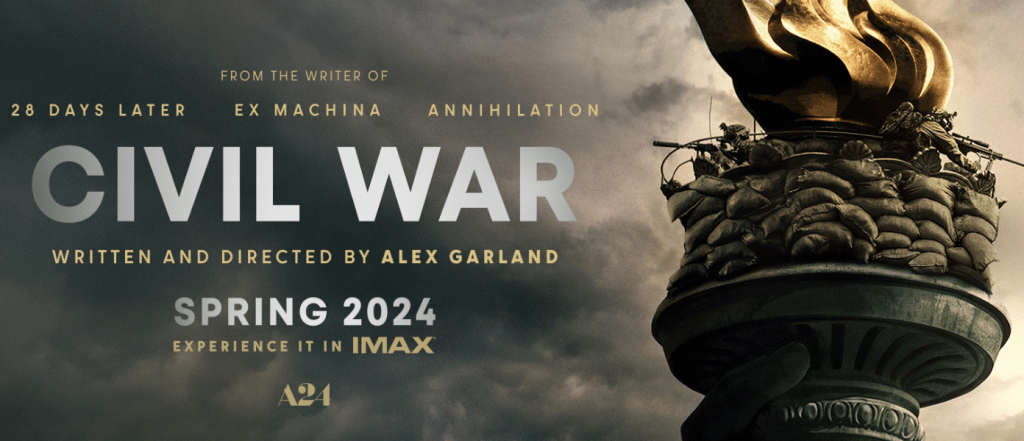
Alex Garland’s “Civil War” emerges not merely as a cinematic exploration but as a poignant reflection on the historical shadows that loom large over American interventionism, particularly in Central America—a region that bears the scars of U.S. foreign policy and its divisive tactics. As a Puerto Rican, my perspective is inevitably colored by the complex history of U.S. involvement in Latin America and the Caribbean, where the echoes of political and military interventions continue to reverberate, shaping the socio-political landscape to this day.
While ostensibly focused on a hypothetical civil strife within the United States, Garland’s film resonates with a bitter familiarity for those who have witnessed the real-life consequences of such divisions fostered from afar. The narrative’s central premise, that of a nation divided against itself, catalyzed by the despotic overreach of a tyrannical president, mirrors the historical experiences of countries like Guatemala, Nicaragua, and El Salvador. Artist Doug Ashford chronicles these events through an archive of ephemera part of a project part of Artists’ Call Against US Intervention in Central America, a nationwide mobilization of writers, artists, activists, artists organizations, and solidarity groups in the US in 1982.
By choosing to center the story around war photographers—witnesses to the unfolding horrors yet ostensibly neutral—Garland subtly critiques the observer role, a position the United States has often claimed in the aftermath of its interventions. This choice compels the audience to consider the implications of witnessing injustice and violence without intervention, paralleling the international community’s frequent inaction in the face of Latin America’s turmoil.
Yet, the film’s deliberate vagueness, its refusal to assign explicit blame to any one faction or ideology, strikes a dissonant chord. While intended to universalize the film’s message and appeal to a broader audience, this narrative ambiguity can be seen as a missed opportunity to confront the specificities of American imperialism and its fallout. In Latin America, the consequences of U.S. interventionism are not abstract notions but lived realities marked by loss, displacement, and the struggle for justice and reconciliation.
Furthermore, the film’s portrayal of journalists as detached observers raises questions about the media’s role in shaping public perception and policy. In the context of U.S. interventions in Latin America, the American media has often played a crucial role in either highlighting injustices or obscuring the full impact of U.S. actions abroad. Garland’s decision to focus on the emotional journey of these characters, while resonant, perhaps glosses over the complex ethical considerations of reporting on conflict—of how narratives are constructed, whose voices are amplified, and whose are silenced.
“Civil War” highlights the real-world consequences of division and intervention through its speculative lens. For those of us in Puerto Rico and throughout Latin America, the film’s themes are not mere hypotheticals but reflections on a historical legacy of interference and its ongoing impact. It serves as a reminder of the need for a critical examination of not only the immediate effects of conflict but also the deeper roots of division—often intertwined with powerful nations’ policies and actions.
In closing, Garland’s “Civil War” stands as a compelling narrative that, intentionally or not, invites viewers to reflect on the broader implications of internal division, the role of the observer, and the reverberations of conflict. For Puerto Ricans and many others affected by U.S. policies abroad, the film underscores the importance of confronting and understanding these complex histories as we seek to navigate our collective futures.
 Ángel Rafael Vázquez-Concepción